
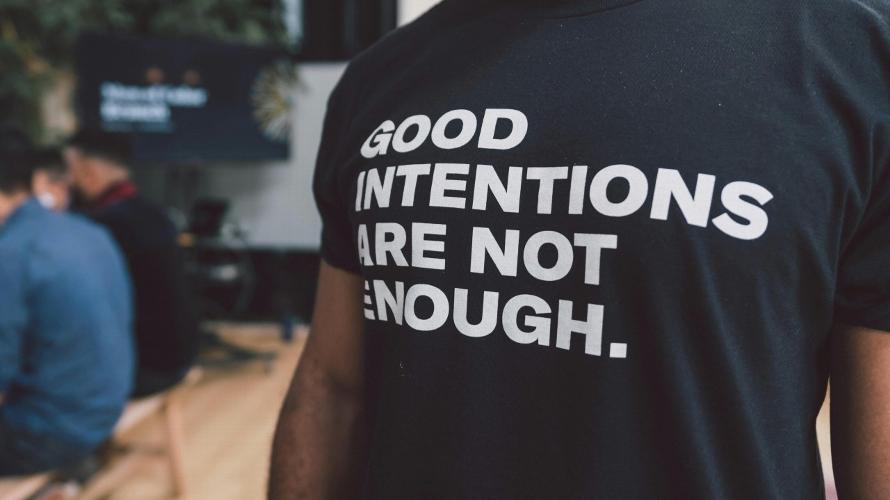
“But that's not what I meant.”
I've definitely said that before, probably more times than I'd like to admit.
You say something and it lands badly. You send an email and someone reads it completely differently to how you intended it. Or you ask someone to do something that seemed perfectly clear in your own head, only for what comes back to be nowhere near what you thought you'd asked for.
Normally, we explain ourselves. That's not what I meant. And whilst that might be completely true, there's a problem with it. The other person never had access to what we meant in the first place. They only had access to what we actually said and did.
The more I think about that, the more interesting it becomes, because we naturally judge ourselves by our intentions. We know what we were trying to achieve, we know we care and we know the values we hold and the type of person we're trying to be.
Everyone else gets a different view of us. They get our behaviour.
And whether we're talking about leadership, performance, relationships or just life in general, I'm becoming increasingly convinced that behaviour is the foundation everything else sits on. Our intentions might explain where we were trying to get to, but our behaviour is what other people actually experience along the way.
What Actually Happened?
Imagine three groups of people being given exactly the same task.
The first gets a really clear brief. They understand why they're doing it, what's expected of them and what good looks like, with an opportunity to ask questions and make sure everyone is on the same page before they start.
The second group gets all the correct information as well, but this time it's rushed, full of jargon and there's very little explanation around why any of it actually matters. The third gets something closer to a car crash, with interruptions, ambiguity and different pieces of information arriving at different times.
Then all three groups crack on.
Same underlying task, same intent behind it, but three completely different outcomes because of how that intent was delivered.
I find that fascinating because you could quite easily imagine the person giving any one of those briefs walking away thinking, Well, I told them. And technically, they did. But telling someone something and creating genuine understanding are two very different things.
I've been guilty of confusing the two plenty of times. I sent the email, we spoke about it yesterday, it was covered in the meeting, so surely everyone knows what's happening?
Maybe. But what actually landed?
Because the measure of my communication probably isn't what left my mouth – it's what arrived in your head. And underneath that sits a whole collection of behaviours that influenced whether it arrived intact. Perhaps I rushed because I was busy, assumed people understood because nobody challenged me, or noticed somebody looked confused but carried on anyway because I had somewhere else to be.
None of that necessarily changes what I intended.
It absolutely changes what you experienced.
Behaviour Makes the Invisible Visible
This is probably the part I keep coming back to.
Values matter. Of course they do. So do our beliefs, principles, purpose and intentions, but they all share the same problem: nobody else can actually see them.
You can't see my integrity or humility. You can't see whether I genuinely care about the people around me, and you certainly can't climb inside my head and see what I intended to happen.
What you can see is how I behave.
So if I tell you that integrity matters to me, there needs to be something attached to that which you can actually observe. If I say I value my people, there should probably be some evidence of that in how I treat them. And if I bang on about accountability but suddenly become very good at finding excuses when I'm the one who gets something wrong, then my behaviour has probably told you far more about me than the value ever did.
The same applies to being approachable. I can genuinely believe that my door is always open, but if people are nervous about walking through it because of how I react when they do, at some point I probably need to stop reassuring myself that I'm approachable and become curious about why their experience of me is different.
That's uncomfortable, but I think that's where some of the useful stuff sits.
Our values don't become real because we say them often enough. They become real when someone can see them in our behaviour.
Integrity, respect, courage, humility and accountability all sound brilliant written down. Most organisations probably have some version of them somewhere. The interesting question is what those words look like on a wet Tuesday morning when everyone is tired, something has gone wrong and the pressure is starting to build.
That's when they count.
The Version of You That Turns Up on the Bad Days
Most of us are probably fairly good versions of ourselves when everything is going well. You've slept properly, things are good at home, work isn't completely mental, you've got some time and nobody has annoyed you before your first coffee. Being patient, considered and approachable isn't particularly difficult in those conditions.
Unfortunately, life doesn't always play along.
Sometimes you haven't slept properly. There might be something going on at home, your workload is through the roof or you're carrying something around that nobody else knows about. Then somebody asks you a perfectly reasonable question at exactly the wrong moment.
What happens next matters, because the person standing in front of you might know absolutely nothing about what is going on in your world. They simply experience the version of you that turned up that day.
Your personal world has just become somebody else's experience of you.
I don't think the answer is pretending none of that affects us or trying to become some sort of emotionless robot. We all have bad days, get tired and frustrated, and sometimes get things completely wrong. I certainly have.
For me, the important part is becoming better at noticing what is driving my behaviour before somebody else has to experience the consequences of it. I might not have much control over what happened before I walked through the door that morning, but I can start to have some influence over what I carry through it.
That little bit of awareness creates choice, and choice gives us the opportunity to behave differently.
People Watch What We Do
I spent 22 years in the Royal Marines and, when I think back to the people who influenced me most, I honestly don't remember many of the things they actually told me about leadership.
What I remember is how they behaved.
I remember people who stayed calm when everything around them was going wrong, who treated the most junior person in the room with the same respect they gave the most senior and who were comfortable admitting when they'd got something wrong. There were also people who somehow made you want to raise your own standards simply because of the standards they held themselves to.
Equally, I remember the opposite. We all do.
That's because behaviour leaves a mark. You can stand in front of a team and talk about standards for an hour, then walk out of the room and behave in a way that contradicts everything you've just said. I'm fairly confident I know which message people will remember, and it probably isn't the PowerPoint.
People are constantly watching what we do, often learning from us when we don't even realise we're teaching. That applies way beyond formal leadership as well. Our children do it, our teammates do it and the people we work alongside do it. They pick up little signals about what genuinely matters to us through the way we behave when life is actually happening.
It's not what we say that matters. What we show matters.
When Nobody Has to Follow You
This becomes even more obvious when you remove rank, position or authority from the equation.
For a long time, I worked in an environment where rank meant something. There was a clear chain of command and authority attached to certain positions, but when I look back, the best people I worked with rarely needed to lean heavily on any of it.
You wanted to follow them, and I think there's a huge difference between someone having to follow you and someone choosing to.
Their credibility came from what they repeatedly did. There was consistency between their words and their actions and, importantly, when things became difficult, you had a fairly good idea which version of them was going to turn up.
That matters when you're leading your own team, but I think it becomes even more important when you're trying to influence somebody who doesn't have to listen to you. They might sit in a different team or organisation, come from a completely different background and have priorities that don't necessarily align with yours.
At that point you can't really hide behind the badge on your chest or the title underneath your email signature. You're relying on credibility, and credibility isn't something we get to announce about ourselves. Other people decide whether we have it, normally through repeated experiences of our behaviour.
What Actually Landed?
There's a question I've become quite fond of asking:
What actually landed?
I think it's useful because it moves us away from what I intended to say or what somebody else should have understood and forces us to become curious about what they actually experienced.
That could be after a difficult conversation, giving someone feedback, coaching somebody, having an argument at home or simply walking away from a meeting where you're not entirely convinced everyone left with the same understanding.
There can be a considerable gap between what I intended and what you experienced, and I'm not sure I close that gap by explaining my intentions louder. I probably make more progress by looking at my own behaviour and asking myself whether the way I communicated, listened and responded helped create the outcome I wanted.
There's a bit of humility required in that, particularly when the answer isn't very flattering.
But I'd rather notice the gap than keep explaining why it shouldn't exist.
Monday Morning
Ultimately, none of this matters much unless something changes.
We can read about leadership, talk about values, listen to podcasts, go on courses, write things in notebooks and have some genuinely brilliant conversations about the people we want to become.
Then Monday morning arrives and we behave exactly as we did before.
So perhaps the useful question isn't particularly complicated:
What will I actually do differently?
Not what my team should change, what my boss needs to improve or what the organisation ought to do better. What am I going to do differently?
Because my intentions belong to me. So do my values and beliefs. They matter enormously, but the only way any of them become real to the people around me is through my behaviour.
We spend a lot of time thinking about the person we intend to be. Every now and again, I think it's worth being brave enough to ask what kind of person other people actually experience when we walk into the room.
There will probably be a gap between the two. I know there is for me, and I'm not sure the aim is pretending we can ever remove it completely.
The work is noticing it, owning our part in it and then trying to close that gap through what we do next.
Because ultimately, people can't see our intentions.
They can only experience our behaviour.